

If you are reading this article, you might have never encountered SEO before, or you might already know a bit about it from other channels. But in this article, I will dissect the essence of SEO for you, giving you a comprehensive (and perhaps entirely new) understanding of it.
Before we begin, please remember one sentence, which is also the essence of SEO: Understand the user's search intent.
What Exactly is SEO?
SEO stands for Search Engine Optimization. The search engines here might include Baidu, Google, Yahoo, Bing, etc., which you use every day. Its purpose is to get more people to enter your website through search engines, and this traffic is also known as organic traffic (free traffic).
So what do we mean by optimization?
Optimization certainly doesn't mean we are going to optimize the algorithms of these search engines, but rather the performance of the website in these search engines, such as exposure, clicks, rankings, etc. Have you ever wondered, when you enter a search term in a search engine, why some website pages appear at the top of the search results page, while others are at the bottom? Here we need to introduce a concept, namely "Ranking", which refers to the order of a page in the Search Engine Results Page (SERP) for a specific search term.
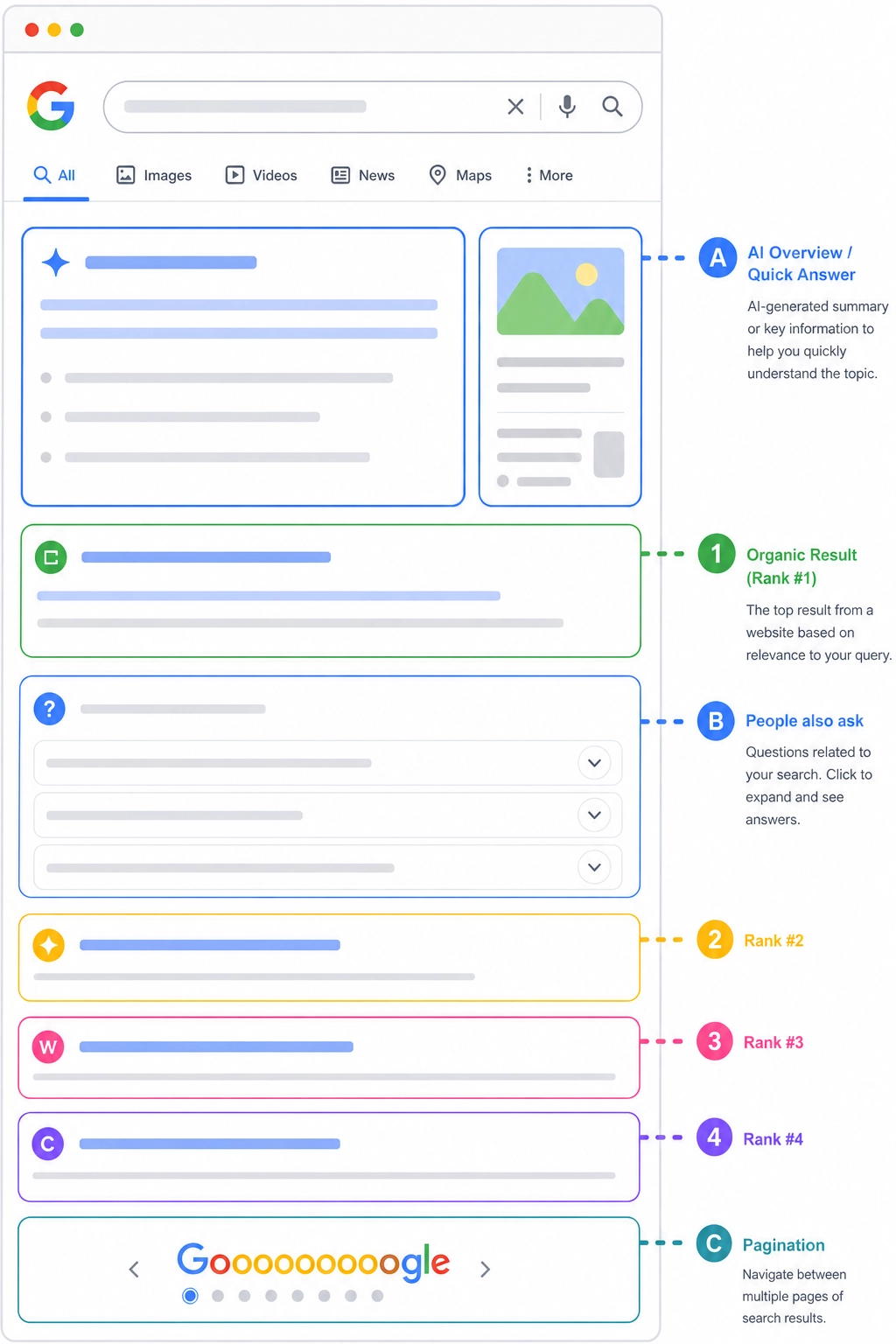
Above is an example image of a search results page. In addition to regular organic rankings, we can also see other content such as AI Overview and People also ask, but we won't introduce them here for now.
Up to this point, I believe you have guessed what Optimization in SEO refers to. Yes, it is optimizing the website page's ranking performance in the SERP. This is also the ultimate goal of SEO (but not its essence). The higher the ranking of a page, the easier it is for users to see it. Once seen, it is more likely that users will click and enter your website. Congratulations, you just got +1 Traffic (Click)!
How to Do SEO Well to Improve Ranking Performance?
If you are reading this, it means you already know the ultimate goal of SEO and want to understand/learn how to improve your website's ranking. But I won't tell you exactly how to improve rankings here because it is a massive and complex engineering task. The required work might be entirely different for different industries or types of websites.
But don't rush to leave just yet. Before carrying out SEO work, we must first understand what factors affect rankings. Here we need to step out of conventional logical thinking and ponder why some pages rank high while others rank low, and why the results in the SERP for the same search term might even differ across different search engines.
Here we need to know a concept: the ranking order is determined by a set of algorithms written by various search engine service providers. Their algorithms will judge which page should rank first and which should rank tenth based on the search terms entered by the user and their existing data. There are numerous factors affecting the ranking order here, coming from both the users and the websites themselves.
How Do Users Affect Page Rankings in SERPs?
In today's big data era, many service providers like to recommend personalized content based on user data, and this is equally true in the search engine industry. Various algorithms will personalize the ranking order of webpages in the SERP based on users' past behavioral data to achieve a customized experience for each individual. This behavior is explicitly mentioned in Google's Help Center.
In addition to users' past behavior, factors such as the user's location, language used, whether SafeSearch is enabled, and incognito mode will all affect the final search results they see. Don't have a concept of this? Why not do a little experiment yourself? Open your browser, use the same search engine in both regular and incognito modes, and search for something you frequently look up. You will find that the results are not exactly the same.
Another very important point is that the user's behavioral data on the website will also affect the website's ranking in the SERP. To help you understand this intuitively, let's do a scenario role-play.
During a timed online exam, you encounter a question you have no idea how to solve. Under time pressure, you secretly search for the answer on Google and eagerly click into the first result in the SERP. However, you discover that you have to register an account to unlock the answer. You immediately return to the SERP and click into the second page, only to find that it's not the answer to your question at all. You return to the SERP again. Finally, you find the answer on the third page. At the same time, you discover that this website also has the answers to other questions in this exam. Therefore, you browse around this website and finish all the questions.
Let's assume we stayed on the first and second pages for less than 2 seconds before leaving, but we stayed on the website of the third page for 10 minutes and continuously navigated through different pages on the site (because we could find the information we wanted there). The search service provider records this behavior; it knows that the website of the third page is more useful to the user. When more and more users click into the third page and stay for a long time, the algorithm will boost its ranking based on these behavioral data so that other users with similar needs can find what they want faster.
How Does a Website Itself Affect Its Ranking in SERPs?
Some attributes of the website itself also affect its ranking performance in the SERP. In practical daily work, SEO optimization is usually systematically divided into three core sectors (which are also the three major themes we will gradually unpack for you in subsequent courses):
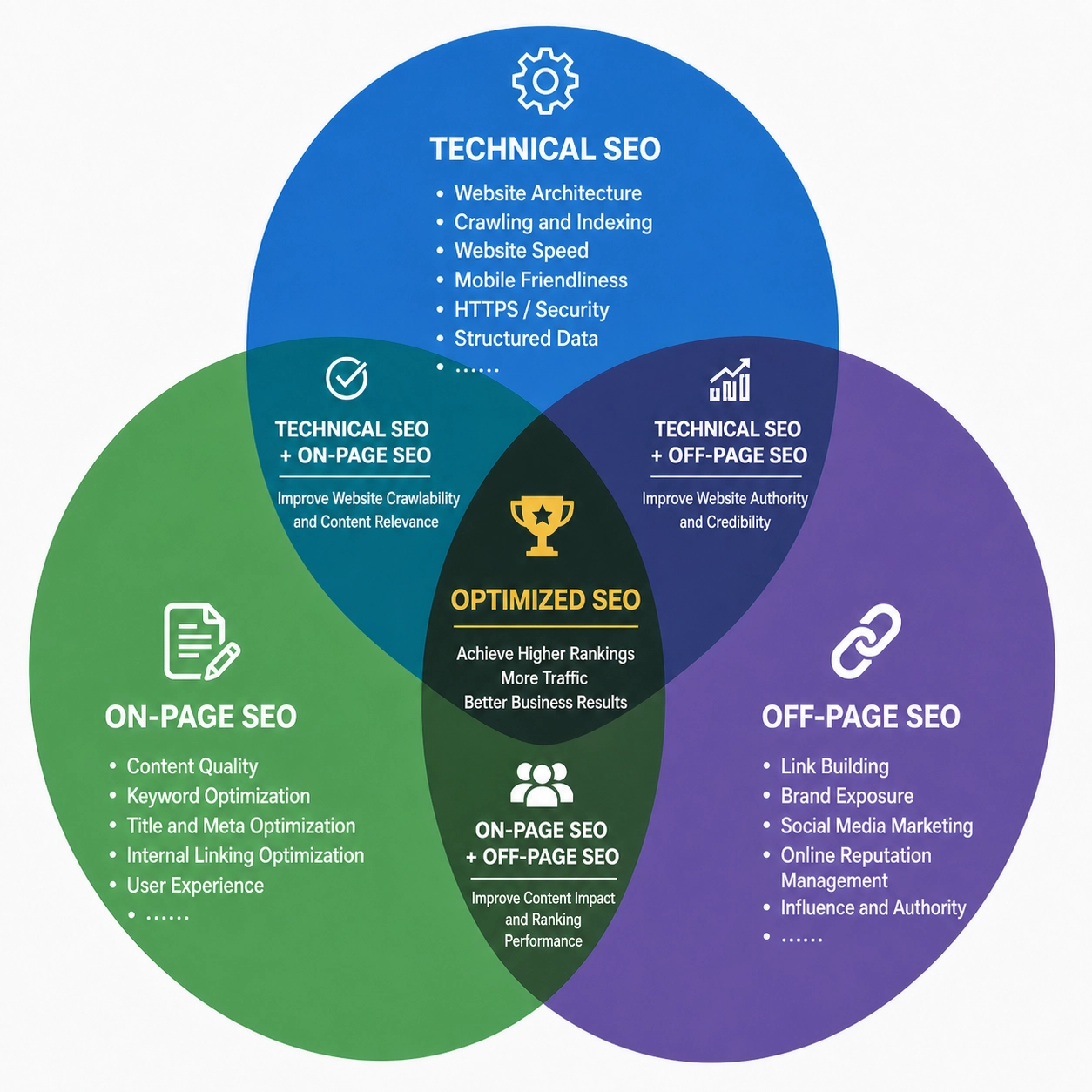
1. Technical SEO Let's use an analogy first. Suppose you open a large supermarket with a dazzling array of goods and celebrity endorsements. However, the supermarket doors often get stuck and won't open (website downtime), the aisles inside are like a maze without a single directional sign (chaotic website structure), and you even have to wait half an hour in line to check out (extremely slow page loading speed). Do you think customers will come back next time?
Technical SEO is meant to solve these problems; it acts as the foundation of the entire website. It requires your website to load fast, be comfortably formatted for browsing on mobile phones (mobile-friendly), have a clear URL link structure, and ensure secure data transmission (HTTPS). More importantly, you need to ensure that the search engine's "spider" can successfully enter your website and read your page code. If search engines can't even enter your webpage, no matter how high your theoretical ranking might be, it's just a fantasy.
2. On-page SEO Once the foundation is laid, the next thing is the goods displayed in the supermarket, which is the specific content on your website pages. Optimization targeting elements such as text, images, and structure on a single page is what we call On-page SEO. All the authority and technical optimization ultimately have to land on your "content".
Now, let's return to the sentence I asked you to remember at the beginning of the article—the essence of SEO is: Understand the user's search intent. Suppose a user searches for "how to make braised pork." Their intent is very clear: they need a detailed, easy-to-understand recipe. At this time, if your page provides step-by-step instructions with pictures and texts, or even a demonstration video, and clearly lists the ingredients and quantities needed, then your page is of high quality because it perfectly solves the user's need.
Conversely, if your page writes a lengthy essay introducing the historical origins of braised pork, discussing the relationship between Su Dongpo and braised pork, and only hastily jots down a few sentences on how to cook it at the end. Even though your word count is high, this deviates from the user's search intent, and the user will close it at a glance. Therefore, creating valuable content that directly addresses users' pain points and logically arranging the vocabulary users will search for is the core of On-page SEO.
3. Off-page SEO The supermarket is built, and the goods are on the shelves; next, you need others to help you promote it. This involves optimization work that happens outside your website, which is Off-page SEO. It primarily solves the problem of the website's "authority" and "reputation".
Imagine you are sick and need to find a doctor. Would you choose a small clinic that just opened with no reviews, or a top-tier hospital with a long history that is endorsed by multiple medical experts with their real names? Without a doubt, the vast majority of people would choose the latter because the latter has more "authority."
The search engine is the same. How does it judge whether a website is authoritative? The most direct way is to see "who is recommending you." In the internet world, when one website links to another, it is equivalent to casting a "vote of confidence." If many other high-quality, highly authoritative websites put your website's link (known in the industry as "Backlinks"), the search engine will think: "Wow, so many big shots think your content is good, then you must be very reliable." Thus, it is more willing to give you a good ranking.
Conclusion: SEO is a Marathon Without a Finish Line
Seeing this, I believe SEO is no longer unfamiliar to you. It's neither some hacker technology nor a magic trick that can make you rich overnight.
With the advancement of technology and the development of AI, search engine algorithms are changing every day, becoming smarter and smarter, more and more like a real human. Those tactics that try to deceive the algorithm through cheating methods (such as frantically stuffing keywords or buying spam backlinks) will eventually be eliminated.
As long as you keep in mind the essence of SEO—understanding and satisfying users' search intent, and persistently providing users with valuable content and a good browsing experience—you have already mastered the core passcode to clearing the SEO game. The rest just needs to be left to time and persistence.