
In this article, I will briefly explain what On-page SEO is, what role it plays in SEO, and why we need to do it. After reading, you will have a basic understanding of On-page SEO and know where to start learning.
What is On-page SEO?
On-page optimization (hereafter referred to as On-page SEO) is one of the optimization directions in SEO, which together with Technical SEO and Off-page SEO forms the entire SEO framework. On-page SEO determines whether your website pages will be indexed, what keywords will get impressions after being indexed, and whether your traffic will be stable in the long term.
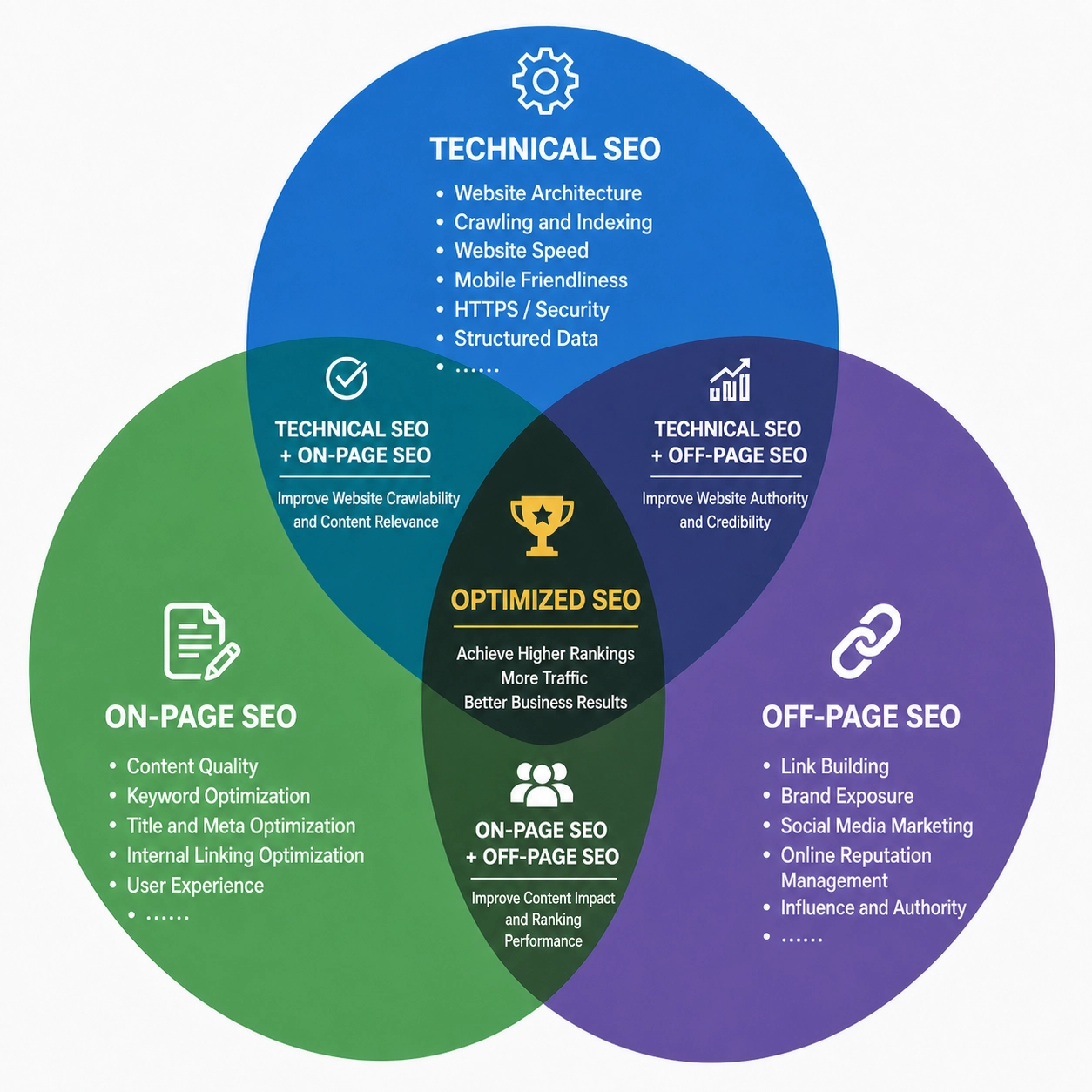
Simply put, the core of On-page SEO is: making sure search engines understand your content, while making users feel your content is valuable.
It mainly revolves around the "page itself," including the following elements:
- Content quality
- Keyword optimization
- Title & description optimization
- User experience
- Internal linking optimization
If you have read our SEO introduction article, you should still remember that the essence of SEO is understanding the user's search intent. Therefore, On-page SEO plays a very important role in SEO. Does your content match the user's intent? In other words, does your content satisfy the user's needs when they search?
For example, when a user searches for "how to make Mapo Tofu" in a search engine, their intent is to know how Mapo Tofu is cooked. If you want to capture the traffic for this search term, your page's topic should be "how to make Mapo Tofu," rather than less relevant content such as "the origin of Mapo Tofu."
This is just a very simple example. If you don't fully grasp it yet, don't worry too much. In our subsequent courses, we will learn about each element in detail, allowing you to have a fuller understanding of On-page SEO and apply what you've learned in practice.
Why Do We Need On-page SEO?
On-page SEO is highly important; it determines whether your page can acquire traffic and whether that traffic meets your expectations. Generally speaking, our primary goal in doing SEO is to acquire more organic traffic for a website. However, in reality, you might need to adjust the type of traffic you currently need based on various factors, such as the targets set by your team/company, the industry your website operates in, the nature of your website, and its current stage.
Once you have determined the type of traffic your website currently needs, you need to adjust the page's content information to attract that specific type of traffic. Let's go back to the Mapo Tofu example. After you publish a guide on "how to make Mapo Tofu," your team notices it's getting good traffic. Now they want to convert this traffic, encouraging page visitors to buy the company's new Mapo Tofu meal kit. Therefore, you add content related to the Mapo Tofu meal kit to the page. This content might help the page gain impressions for semantically related search terms like "buy Mapo Tofu pre-made meals"—which are precisely high-converting keywords.
So, through content adjustments on a page, we can control what kind of traffic that page acquires. The example above is very simple; real-world workflows will be far more complex.
What Does a Website with Good On-page SEO Look Like?
A website that meets the standards of good On-page SEO should have the following characteristics:
- The search terms the website gets impressions for are relevant to its industry (e.g., a used car trading website should have impressions for keywords like "used car trading," "2024 used Toyota Camry," "car valuation," etc.).
- User behavior metrics reach the industry median level (e.g., bounce rate, time on page, conversion rate, downstream traffic contribution, etc.).
- Internal links have a unified standard (e.g., the anchor text for the same page within the site should be semantically consistent).
- It has Topic Clusters (e.g., possessing pillar pages and subset content pages. For instance, if "Toyota used cars" is the core keyword of your pillar page, you should have subset pages targeting "Toyota Corolla used cars," "Toyota Highlander used cars," etc., as their core keywords).
Conclusion
On-page SEO is not overly complicated. Especially when you put yourself in the users' shoes to understand the intent behind their searches and their browsing experience upon entering your site. By optimizing your pages based on these two points and exercising a bit of patience, I believe you will definitely ride the wind and waves in the SERPs!